|
 The state flag was adopted on June 5, 1911 by an act of the General
Assembly. The flag was adopted to be used on all occasions when the
state is officially and publicly represented, with the privilege of
use by all citizens upon such occasions as they deem fitting and
appropriate. Laws pertaining to use of the National flag are also
applicable to use of the State flag.
The state flag was adopted on June 5, 1911 by an act of the General
Assembly. The flag was adopted to be used on all occasions when the
state is officially and publicly represented, with the privilege of
use by all citizens upon such occasions as they deem fitting and
appropriate. Laws pertaining to use of the National flag are also
applicable to use of the State flag.
The flag consists of three alternate stripes of equal width and at
right angles to the staff, the two outer stripes to be blue of the
same color as in the blue field of the national flag and the middle
stripe to be white, the proportion of the flag being a width of
two-thirds of its length. At a distance from the staff end of the flag
of one fifth of the total length of the flag there is a circular red
C, of the same color as the red in the national flag of the United
States. The diameter of the letter is two-thirds of the width of the
flag. The inner line of the opening of the letter C is three-fourths
of the width of its body or bar, and the outer line of the opening is
double the length of the inner line thereof. Completely filling the
open space inside the letter C is a golden disk, attached to the flag
is a cord of gold and silver, intertwined, with tassels, one of gold
and one of silver.
The flag was originally designed by Andrew Carlisle Johnson in
1911. Precise colors of red and blue were not designated in the 1911
legislation and some controversy arose over these colors. On February
28, 1929, the General Assembly stipulated the precise colors of red
and blue as the same as the national flag. Controversy also arose over
the size of the letter C and on March 31, 1964, the General Assembly
further modified the 1911 legislation by revising the distance from
the staff for the letter C and its diameter. Citations: Senate Bill
118, 1911; Senate Bill 152, 1929; Senate Bill , 1964.
Flag Chronology
The geographical territory which comprises the present day State of
Colorado has historically been under many flags.
- Coronado's expedition into the Southwest in 1540-42 gave
substance to Spain's claim to the entire western interior region
to the United States.
- In 1662, when LaSalle floated down the Mississippi River, he
claimed for the French King the entire drainage area of the
"Father of Waters", which included a substantial area of
Colorado.
- During the 17th and 18th centuries, the British Colonies of New
England and Virginia extended their theoretical boundaries all the
way to the Pacific Coast, overlapping the French and Spanish
claims.
- Between 1763 and 1848, Colorado belonged in varying proportions
to France, Spain, Mexico and the Republic of Texas.
- In 1803, when Napoleon withdrew his claims to the West and
negotiated the Louisiana Purchase, a part of Colorado came under
U.S. jurisdiction for the first time.
- Between 1803 and 1861, various flags of the District of
Louisiana (part of Indiana Territory), Territory of Louisiana,
Missouri Territory, the State of Deseret (predecessor to Utah),
Utah Territory, New Mexico Territory, Nebraska Territory, Kansas
Territory; and last, Colorado Territory.
- On February 28, 1861, when Colorado Territory was created, the
present boundaries were established and have remained unchanged to
the present time.
- On August 1, 1876, Colorado became the 38th State to enter the
Union under the flag of the United States.
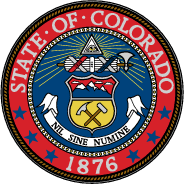 The circular Seal of the State of Colorado is an adaptation of the
Territorial Seal which was adopted by the First Territorial Assembly
on November 6, 1861. The only changes made in the Territorial Seal
design being the substitution of the words, "State of
Colorado" and the figures "1876" for the corresponding
inscriptions on the territorial seal. The first General Assembly of
the State of Colorado approved the adoption of the state seal on March
15, 1877. The Colorado Secretary of State alone is authorized to affix
the Great Seal of Colorado to any document whatsoever.
The circular Seal of the State of Colorado is an adaptation of the
Territorial Seal which was adopted by the First Territorial Assembly
on November 6, 1861. The only changes made in the Territorial Seal
design being the substitution of the words, "State of
Colorado" and the figures "1876" for the corresponding
inscriptions on the territorial seal. The first General Assembly of
the State of Colorado approved the adoption of the state seal on March
15, 1877. The Colorado Secretary of State alone is authorized to affix
the Great Seal of Colorado to any document whatsoever.
By statute, the seal of the State is two and one-half inches in
diameter with the following devices inscribed thereon: At the top is
the eye of God within a trangle, from which golden rays radiate on two
sides. Below the eye is a scroll, the Roman fasces, a bundle of birch
or elm rods with a battle axe bound together by red thongs and bearing
on a band of red, white and blue, the word, "Union and
Constitution." The Roman fasces is the insignia of a republican
form of government. The bundle of rods bound together symbolizes
strength which is lacking in the single rod. The axe symbolizes
authority and leadership. Below the scroll is the heraldic shield
bearing across the top on a red ground three snow-capped mountains
with clouds above them. The lower half of the shield has two miner's
tools, the pick and sledge hammer, crossed on a golden ground. Below
the shield in a semicircle is the motto, "Nil Sine Numine",
Latin words meaning "nothing without the Deity", and at the
bottom the figures 1876, the year Colorado came into statehood.
The design for the Territorial Seal which served as a model for the
State Seal or Great Seal of Colorado has been variously credited, but
the individual primarily responsible was Lewis Ledyard Weld, the
Territorial Secretary, appointed by President Lincoln in July of 1861.
There is also evidence that Territorial Governor William Gilpin also
was at least partially responsible for the design. Both Weld and
Gilpin were knowledgable in the art and symbolism of heraldry.
Elements of design from both the Weld and Gilpin family coat-of-arms
are incorporated in the Territorial Seal.
Nil Sine Numine
The Latin phrase "Nil Sine Numine", was adopted as part
of the Territorial Seal. At recurring intervals, discussion has ensued
concerning interpretation of this Latin phrase which commonly
translated is "Nothing without Providence". Others say it is
"Nothing without God". In the early mining days of the
State, the unregenerate said it meant "nothing without a new
mine". In a strict sense, one cannot possibly get "God"
from "numine", God being a purely Anglo-Saxon word. The word
"numine" means any divinity, god or goddess. The best
evidence of intent of Colorado's official designers and framers of the
resolution for adoption of the seal is contained in the committee
report wherein clear distinction was made between "numine"
and "Deo" and it is specifically states that the committee's
interpretative translation was "Nothing without the Deity".
State Name and Nicknames
The name of our state, Colorado, has its origin in the Spanish
language, as the word for "colored red". This was the name
chosen for Colorado as a Territory in 1861 by Congress.
Colorado has been nicknamed the "Centennial State"
because it became a state in the year 1876, 100 years after the
signing of our nation's Declaration of Independence.
Colorado also is called "Colorful Colorado" presumably
because of our magnificent scenery of mountains, rivers and plains.
This phrase has decorated maps, car license plates, tourist
information centers and souvenirs of all kinds!
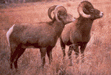 The Rocky Mountain Bighorn Sheep, Ovis canadensis, was
adopted as the official state animal on May 1, 1961 by an act of the
General Assembly. The Rocky Mountain Bighorn Sheep is found only in
the Rockies, usually above timberline in rugged mountainous areas. The
male sheep is three to three and a half feet tall at the shoulder and
weighs up to three hundred pounds, while the female is slightly
smaller. These large animals are known for their agility and perfect
sense of balance. The bighorn sheep was named for its massive horns
which curve backward from the forehead, down, then forward. On the ram
the horns can be as much as fifty inches in length. It is unlawful to
pursue, take, hunt, wound, or kill the Rocky Mountain Bighorn Sheep
except as provided by law. Citation: Senate Bill 294, 1961; Colorado
Revised Statute 24-80-911.
The Rocky Mountain Bighorn Sheep, Ovis canadensis, was
adopted as the official state animal on May 1, 1961 by an act of the
General Assembly. The Rocky Mountain Bighorn Sheep is found only in
the Rockies, usually above timberline in rugged mountainous areas. The
male sheep is three to three and a half feet tall at the shoulder and
weighs up to three hundred pounds, while the female is slightly
smaller. These large animals are known for their agility and perfect
sense of balance. The bighorn sheep was named for its massive horns
which curve backward from the forehead, down, then forward. On the ram
the horns can be as much as fifty inches in length. It is unlawful to
pursue, take, hunt, wound, or kill the Rocky Mountain Bighorn Sheep
except as provided by law. Citation: Senate Bill 294, 1961; Colorado
Revised Statute 24-80-911.
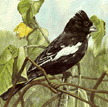 The Lark Bunting, Calamospiza melanocoryus Stejneger, was
adopted as the official state bird on April 29, 1931. The Lark Bunting
is a migrant bird. Flocks arrive in April and inhabit the plains
regions and areas up to 8,000 feet in elevation. They fly south again
in September. The male bird is black with snowy white wing patches and
edgings, tail coverts and outer tail feathers. In winter the male bird
changes to a gray brown like the female bird, however the chin remains
black and the black belly feathers retain white edgings. The female
bird is gray brown above and white below with dusky streaks. The male
bird is six to seven inches while the female is slightly smaller. The
male bird performs a spectacular courtship flight, during which he
warbles and trills a distinctive mating song. Citation: House Bill
222, 1931; Colorado Revised Statute 24-80-910.
The Lark Bunting, Calamospiza melanocoryus Stejneger, was
adopted as the official state bird on April 29, 1931. The Lark Bunting
is a migrant bird. Flocks arrive in April and inhabit the plains
regions and areas up to 8,000 feet in elevation. They fly south again
in September. The male bird is black with snowy white wing patches and
edgings, tail coverts and outer tail feathers. In winter the male bird
changes to a gray brown like the female bird, however the chin remains
black and the black belly feathers retain white edgings. The female
bird is gray brown above and white below with dusky streaks. The male
bird is six to seven inches while the female is slightly smaller. The
male bird performs a spectacular courtship flight, during which he
warbles and trills a distinctive mating song. Citation: House Bill
222, 1931; Colorado Revised Statute 24-80-910.
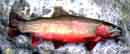 The Greenback Cutthroat Trout, Oncorhynchus clarki somias,
was adopted as the official state fish on March 15, 1994, by an act of
the General Assembly. The Rainbow Trout was considered the state fish
from 1954 until 1994, however it was never officially adopted. The
Greenback Cutthroat Trout was at one time indiginous to many small
creeks, streams and rivers throughout most of Colorado. As mining and
human occupation expanded across the state, the greenback easily
succumbed to pollution from mine tailings in the state's streams and
to competition from other species of trout introduced to Colorado
waters. The demise was so complete that up until the late 1980's
biologists feared the extinction of this native fish. However,
researchers in the early 1990's discovered several small populations
of the greenback in a few remote streams in Rocky Mountain National
Park. Colorado Division of Wildlife and National Park personnel took
immediate steps to protect and propogate the greenback. Plans have
been made to reintroduce this colorful fish to other waters within the
state which are suitable for its repopulation. Citation: House Bill
1164, 1994; Colorado Revised Statute 24-80-911.5.
The Greenback Cutthroat Trout, Oncorhynchus clarki somias,
was adopted as the official state fish on March 15, 1994, by an act of
the General Assembly. The Rainbow Trout was considered the state fish
from 1954 until 1994, however it was never officially adopted. The
Greenback Cutthroat Trout was at one time indiginous to many small
creeks, streams and rivers throughout most of Colorado. As mining and
human occupation expanded across the state, the greenback easily
succumbed to pollution from mine tailings in the state's streams and
to competition from other species of trout introduced to Colorado
waters. The demise was so complete that up until the late 1980's
biologists feared the extinction of this native fish. However,
researchers in the early 1990's discovered several small populations
of the greenback in a few remote streams in Rocky Mountain National
Park. Colorado Division of Wildlife and National Park personnel took
immediate steps to protect and propogate the greenback. Plans have
been made to reintroduce this colorful fish to other waters within the
state which are suitable for its repopulation. Citation: House Bill
1164, 1994; Colorado Revised Statute 24-80-911.5.
 The white and lavender Columbine, Aquilegia caerules, was
adopted as the official state flower on April 4, 1899 by an act of the
General Assembly. In 1925, the General Assembly made it the duty of
all citizens to protect this rare species from needless destruction or
waste. To further protect this fragile flower, the law prohibits
digging or uprooting the flower on public lands and limits the
gathering of buds, blossoms and stems to 25 in one day. It is unlawful
to pick the columbine on private land without consent of the land
owner. Citation: Senate Bill 261, 1899, Bill, 1925; Colorado Revised
Statutes 24-80-905 through 24-80-908.
The white and lavender Columbine, Aquilegia caerules, was
adopted as the official state flower on April 4, 1899 by an act of the
General Assembly. In 1925, the General Assembly made it the duty of
all citizens to protect this rare species from needless destruction or
waste. To further protect this fragile flower, the law prohibits
digging or uprooting the flower on public lands and limits the
gathering of buds, blossoms and stems to 25 in one day. It is unlawful
to pick the columbine on private land without consent of the land
owner. Citation: Senate Bill 261, 1899, Bill, 1925; Colorado Revised
Statutes 24-80-905 through 24-80-908.
State Folk Dance
The Square Dance was adopted as the official state folk dance on
March 16, 1992 by an act of the General Assembly. Square dancing is
the American folk dance which traces its ancestry to the English
country dance and the French ballroom dance, and which is called,
cued, or prompted to the dancers and includes squares, rounds,
clogging, contra, line, the Virginia Reel, and heritage dances.
Citation: House Bill 1058, 1992; Colorado Revised Statute 24-80-909.5.
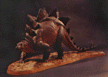 The Stegosaurus was designated as the official state fossil on April
28, 1982 by executive order of Governor Richard D. Lamm. The
Stegosaurus lived in the area we now know as Colorado one hundred and
fifty million years ago during the Mesozoic era in the Jurassic
period. It is believed that a typical Stegosaurus weighed ten tons
though its brain weighed only two and one-half ounces. There are only
6 skeletons of the Stegosaurus on public display in the United States,
one of which may be viewed at the Museum of Natural History in Denver.
This skeleton was discovered by a teacher and students from Canon City
High School.
The Stegosaurus was designated as the official state fossil on April
28, 1982 by executive order of Governor Richard D. Lamm. The
Stegosaurus lived in the area we now know as Colorado one hundred and
fifty million years ago during the Mesozoic era in the Jurassic
period. It is believed that a typical Stegosaurus weighed ten tons
though its brain weighed only two and one-half ounces. There are only
6 skeletons of the Stegosaurus on public display in the United States,
one of which may be viewed at the Museum of Natural History in Denver.
This skeleton was discovered by a teacher and students from Canon City
High School.
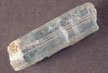 The aquamarine was adopted as the official state gemstone on April 30,
1971, by an act of the General Assembly. The mountain peaks of Mount
Antero and White Mountain in Colorado are among the finest quality
localities known for gem aquamarine. They are also among the highest
in elevation, located at 14,000 feet. The granite rock of these peaks
contains pegmatite bodies that are characterized by large miarolitic
cavities containing the gem quality aquamarine crystals. The cavities
are found through a vertical area of a mere 500 feet. The crystals in
these cavities range in color from light blue to pale and deep
aquamarine green, and in size from very small to 6 cm in length.
Citation: House Bill 1104, 1971; Colorado Revised Statute 24-80-912.
The aquamarine was adopted as the official state gemstone on April 30,
1971, by an act of the General Assembly. The mountain peaks of Mount
Antero and White Mountain in Colorado are among the finest quality
localities known for gem aquamarine. They are also among the highest
in elevation, located at 14,000 feet. The granite rock of these peaks
contains pegmatite bodies that are characterized by large miarolitic
cavities containing the gem quality aquamarine crystals. The cavities
are found through a vertical area of a mere 500 feet. The crystals in
these cavities range in color from light blue to pale and deep
aquamarine green, and in size from very small to 6 cm in length.
Citation: House Bill 1104, 1971; Colorado Revised Statute 24-80-912.
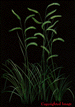 Blue Grama grass was adopted as the official state grass on May 20,
1987, by a resolution of the General Assembly. Blue Grama is a grass
native to the state of Colorado, growing throughout many of the
state's life zones on both sides of the Continental Divide. Grasslands
are an important resource to the State of Colorado with considerable
economic and conservation significance. A state grass was designated
to help inform and educate citizens and tourists about this resource.
Citation: Senate Joint Resolution 13, 1987.
Blue Grama grass was adopted as the official state grass on May 20,
1987, by a resolution of the General Assembly. Blue Grama is a grass
native to the state of Colorado, growing throughout many of the
state's life zones on both sides of the Continental Divide. Grasslands
are an important resource to the State of Colorado with considerable
economic and conservation significance. A state grass was designated
to help inform and educate citizens and tourists about this resource.
Citation: Senate Joint Resolution 13, 1987.
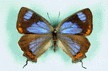 The Colorado Hairstreak Butterfly Hypaurotis cysaluswas
adopted as the official state insect on April 17, 1996. The butterfly
is two inches in width and has purple wings with black borders, orange
accents in the corners and blue on the underside. It may be found on
both sides of the Continental Divide at elevations of 6,500 to 7,500
feet, in its usual habitat of scrub oak ecosystems. Citation: Senate
Bill 122, 1996; Colorado Revised Statute 24-80-913.
The Colorado Hairstreak Butterfly Hypaurotis cysaluswas
adopted as the official state insect on April 17, 1996. The butterfly
is two inches in width and has purple wings with black borders, orange
accents in the corners and blue on the underside. It may be found on
both sides of the Continental Divide at elevations of 6,500 to 7,500
feet, in its usual habitat of scrub oak ecosystems. Citation: Senate
Bill 122, 1996; Colorado Revised Statute 24-80-913.
"Where the Columbines Grow" was adopted as the official
state song on May 8, 1915, by an act of the General Assembly. The
words were written and the music composed by A.J. Fynn.
"Where the Columbines Grow" by A.J. Fynn, 1915
Verse One
Where the snowy peaks gleam in the moonlight,
Above the dark forests of pine,
And the wild foaming waters dash onward,
Toward lands where the tropic stars shine;
Where the scream of the bold mountain eagle
Responds to the notes of the dove
Is the purple robed West, the land that is best,
The pioneer land that we love.
Chorus
Tis the land where the columbines grow,
Overlooking the plains far below,
While the cool summer breeze in the evergreen trees
Softly sings where the columbines grow.
Verse Two
The bison is gone from the upland,
The deer from the canyon has fled,
The home of the wolf is deserted,
The antelope moans for his dead,
The war whoop re-echoes no longer,
The Indian's only a name,
And the nymphs of the grove in their loneliness rove,
But the columbine blooms just the same.
Verse Three
Let the violet brighten the brookside,
In sunlight of earlier spring,
Let the fair clover bedeck the green meadow,
In days when the orioles sing,
Let the golden rod herald the autumn,
But, under the midsummer sky,
In its fair Western home, may the columbine bloom
Till our great mountain rivers run dry.
Sheet music may be ordered through retail sheet music stores. It is
not available from the State of Colorado. Citation: Senate Bill 308,
1915; Colorado Revised Statute 24-80-909.
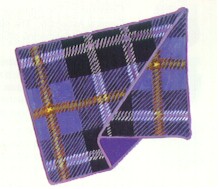 The
Colorado General Assembly passed a resolution adopting an official
state tartan on March 3, 1997. The tartan is comprised of a
pattern and colors that symbolize Colorado's splendor and history. The
pattern or sett consists of primary blocks of forest green and
cerulean blue separated by broad dividing bands of black, with the
forest green checks containing two pairs of tram tracks consisting of
lavender and white and with the cerulean blue checks containing a gold
stripe with red guard lines. The official state tartan is a Celtic and
a "district" tartan that may be worn by any resident or
friend of Colorado whether or not of Celtic heritage. July 1st is
designated as "Tartan Day" in Colorado under House Joint
Resolution 96-1014. An image of the tartan will be available on this
site after the tartan is registered with the International Association
of Tartan Studies. Citation: House
Joint Resolution 97-1016. The
Colorado General Assembly passed a resolution adopting an official
state tartan on March 3, 1997. The tartan is comprised of a
pattern and colors that symbolize Colorado's splendor and history. The
pattern or sett consists of primary blocks of forest green and
cerulean blue separated by broad dividing bands of black, with the
forest green checks containing two pairs of tram tracks consisting of
lavender and white and with the cerulean blue checks containing a gold
stripe with red guard lines. The official state tartan is a Celtic and
a "district" tartan that may be worn by any resident or
friend of Colorado whether or not of Celtic heritage. July 1st is
designated as "Tartan Day" in Colorado under House Joint
Resolution 96-1014. An image of the tartan will be available on this
site after the tartan is registered with the International Association
of Tartan Studies. Citation: House
Joint Resolution 97-1016.
 The
Colorado Blue Spruce, Picea pungens, was adopted as the official state
tree on March 7, 1939, by a resolution of the General Assembly. The
Colorado Blue Spruce was first discovered on Pikes Peak in 1862 and
named by botanist C.C. Parry. This tree is known for its stately,
majestic, symmetrical form and its beautiful silver-blue color. In
Colorado, it grows in small, scattered groves or singly among
ponderosa pine, Douglas fir, alpine fir and Englemann spruce. In the
northern parts of its range it grows at the 6,000 to 9,000 feet
elevation while in the southern parts of its range at 8,000 to 11,000
feet. Its color ranges from green to blue to silver, and is sometimes
called the silver spruce. Colorado school children voted on Arbor Day
in 1892 to name the blue spruce as the state tree, however it was not
until 1939 that the Colorado Blue Spruce was officially designated.
Citation: House Joint Resolution 7, 1939. The
Colorado Blue Spruce, Picea pungens, was adopted as the official state
tree on March 7, 1939, by a resolution of the General Assembly. The
Colorado Blue Spruce was first discovered on Pikes Peak in 1862 and
named by botanist C.C. Parry. This tree is known for its stately,
majestic, symmetrical form and its beautiful silver-blue color. In
Colorado, it grows in small, scattered groves or singly among
ponderosa pine, Douglas fir, alpine fir and Englemann spruce. In the
northern parts of its range it grows at the 6,000 to 9,000 feet
elevation while in the southern parts of its range at 8,000 to 11,000
feet. Its color ranges from green to blue to silver, and is sometimes
called the silver spruce. Colorado school children voted on Arbor Day
in 1892 to name the blue spruce as the state tree, however it was not
until 1939 that the Colorado Blue Spruce was officially designated.
Citation: House Joint Resolution 7, 1939.
|


